
Black Belt Ready
Supporting my son in his journey to earning his black belt.
6/18/20252 min read
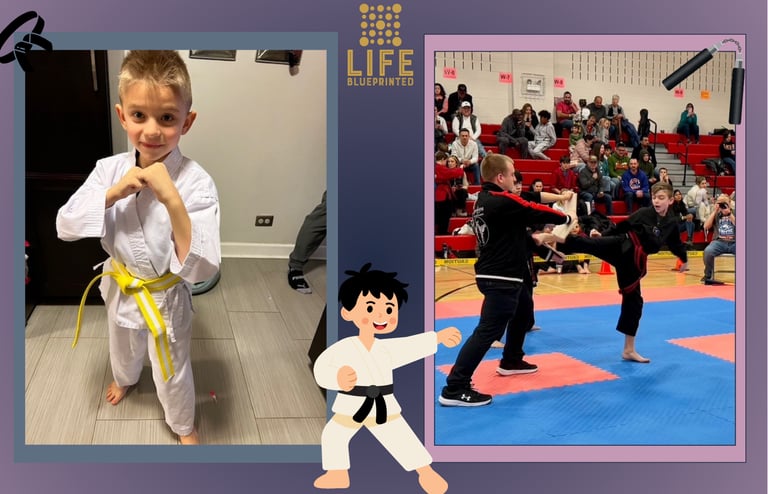
My son started Taekwondo when he was 7. Committing to 3 days a week of drop offs, late dinners, belt graduations, tournaments is a lot in itself. As he continued to grow his skill and rise ranks, the commitment grew and so did the expectations. When he received his deputy red belt (next stop black belt),
He started with a packet.
Inside were the requirements—clear, firm, and non-negotiable:
10 hours of volunteering with outside organizations
30 hours of volunteering inside the dojang
4 full days of empathy training
Plus testing expectations, timelines, and approvals
It was exciting. And overwhelming. Not just for him—but for me.
Because this is how big goals usually show up in real life: as a list of requirements with no clear sense of when or how they fit into everyday schedules.
So instead of saying, “We’ll figure it out,” we did what I’ve learned to do best.
We planned backward.
Big Goals Don’t Fail—Unplanned Ones Do
If we had treated this like a to-do list, it would have looked something like:
Volunteer more
Sign up for empathy training
Track hours
Don’t forget deadlines
That’s not a plan. That’s anxiety disguised as productivity.
Instead, we laid everything out on the table. We started with the end goal—earning his black belt—and worked backward through the requirements.
First, we mapped the non-negotiables:
Empathy training happens on specific dates
Volunteer hours need approval
Hours must be completed before testing eligibility
Once we saw that, everything else became clearer.
Turning Requirements Into a Timeline
We broke the packet into three tracks:
Outside Volunteering (10 hours)
We asked:
What organizations count?
What opportunities are realistic for his age?
How many hours per month makes sense?
Instead of scrambling at the end, we spread the hours out. One or two events at a time. No panic. No cramming.
Inside the Dojang (30 hours)
This seemed huge—until we mapped it.
Assisting classes. Helping younger students. Supporting events. Suddenly, 30 hours wasn’t intimidating—it was doable when spaced across months.
Empathy Training (4 days)
These dates were fixed, so they anchored the entire timeline. Everything else worked around them.
This is the part that matters most:
Once the timeline existed, my son stopped asking, “How am I going to do all of this?” and started asking, “What’s next?”
The Confidence Shift I Didn’t Expect
Backward planning didn’t just organize the requirements—it changed how he felt about the goal.
Instead of carrying everything in his head, he could see it.
Instead of feeling behind, he felt prepared.
Instead of relying on reminders from me, he started tracking his own progress.
And as a parent, I felt something shift too.
I wasn’t nagging.
I wasn’t reminding.
I wasn’t reacting to deadlines creeping up.
We had a blueprint.
This Is Why Backward Planning Works in Real Life
Big goals—whether it’s a black belt, a graduation, or a milestone—aren’t hard because they’re impossible.
They’re hard because they’re unmapped.
Backward planning gives structure to effort. It turns requirements into steps. It replaces pressure with clarity.
And sometimes, it starts with something as simple as a packet on the kitchen table—and the decision to plan before panic sets in.
Because confidence doesn’t come from doing everything at once.
It comes from knowing you’re on track.